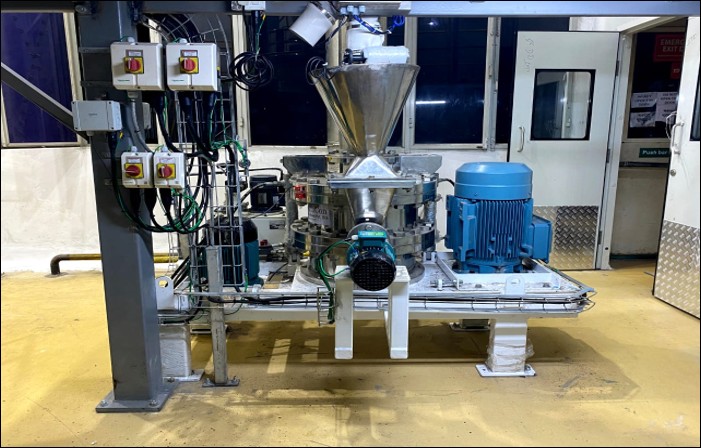
What is a Sugar Grinding System?
A sugar grinding system is an industrial process system used to convert crystal sugar into fine powdered sugar.
The system is commonly used in:
- Biscuit and bakery industries (100–200 Mesh)
- Confectionery plants
- Chocolate manufacturing
- Food ingredient processing
- Pharmaceutical
- Nutraceutical
The final product is generally produced in the range of 4 microns to 400 microns depending on the application requirement.
Main Components of a Sugar Grinding System
A modern sugar grinding system consists of multiple integrated equipment sections for efficient and hygienic operation.
1. Feeding System
The feeding section is designed for controlled and dust-free sugar loading.
- Bag dumping station
- Feeding hopper
- Rotary airlock valve
- Dust extraction arrangement
- Feeding bag filter
This section prevents dust leakage and maintains a clean working environment.
2. Grinding Mill
The grinding mill is the heart of the system where sugar particle size reduction takes place. Commonly used mills include the Air Classifying Mill (ACM) and Universal Mill (UM).
Advantages:
- Fine and uniform grinding
- Narrow particle size distribution
- Adjustable fineness
- High efficiency
- Multi-product applications
3. Pneumatic Conveying System
After grinding, the fine sugar is transferred through a pneumatic conveying system.
Why Pneumatic Conveying is Important
- Dust-free conveying
- Hygienic product handling
- Reduced contamination risk
- Efficient material transfer
- Lower manual handling
Fine Sugar Collection System
Fine sugar is separated from conveying air using a bag filter. Key functions include:
- Fine powder recovery
- Dust control
- Product collection
- Environmental compliance
Why Particle Size Control Matters
Modern systems achieve minimal material loss and maintain negative pressure operation throughout the process. Particle size directly affects:
- Mixing performance
- Product appearance
- Dissolution rate
- Smoothness
- Refining efficiency
- Final product quality
- Better blending
- Consistent icing quality
- Improved surface finish
- Uniform crystallization
Key Technical Features of Modern Sugar Grinding Systems
High Grinding Efficiency: Optimized rotor and grinding chamber design ensure fast and efficient particle size reduction.
Adjustable Fineness Control: Dynamic classifier systems allow precise control over mesh size, micron level output, and particle distribution.
Dust-Free Operation: Integrated bag filters and closed-loop conveying systems ensure clean operation, reduced housekeeping, and safe working conditions.
Hygienic Food-Grade Construction: Most systems are manufactured using SS304 construction with food-grade contact parts and a smooth internal finish, ensuring compliance with food safety requirements.
Energy-Efficient Design: Modern systems are designed for lower power consumption, optimized airflow, and reduced operational cost.
Low Maintenance: Features include easy cleaning access, replaceable wear parts, robust mill construction, and long service life.
Safety Considerations in Sugar Grinding Systems
Sugar dust is combustible in nature. Therefore, safety is extremely important in system design.
Important Safety Features:
- Negative pressure operation
- Proper grounding and earthing
- Explosion venting provisions
- Dust control systems
- Temperature monitoring
Applications of Sugar Grinding Systems
- Biscuit industries
- Chocolate manufacturing plants
- Bakery ingredient processing
- Candy manufacturing
- Instant premix industries
- Pharmaceutical industries
- Food ingredient manufacturing
Why Choose Knitcon Solutions for Sugar Grinding Systems?
Knitcon Solutions specialises in advanced sugar grinding and pneumatic conveying systems designed for food and confectionery industries.
Our Strengths:
- Robust and high-efficiency machine design
- Customised engineering solutions
- Hygienic food-grade systems
- Optimised pneumatic conveying design
- Energy-efficient operation
- Reliable after-sales support
We focus on delivering systems that improve product quality, process efficiency, and operational reliability.
Final Thoughts
A sugar grinding system is a critical process solution for modern confectionery manufacturing. From particle size consistency to dust-free handling, every aspect of the system impacts final product quality and production efficiency.
With the right grinding technology and system design, manufacturers can achieve:
- Consistent product quality
- Reduced material losses
- Higher operational efficiency
- Improved food safety standards
Investing in a technically advanced sugar grinding system helps confectionery manufacturers stay competitive in today's demanding food processing market.