Introduction
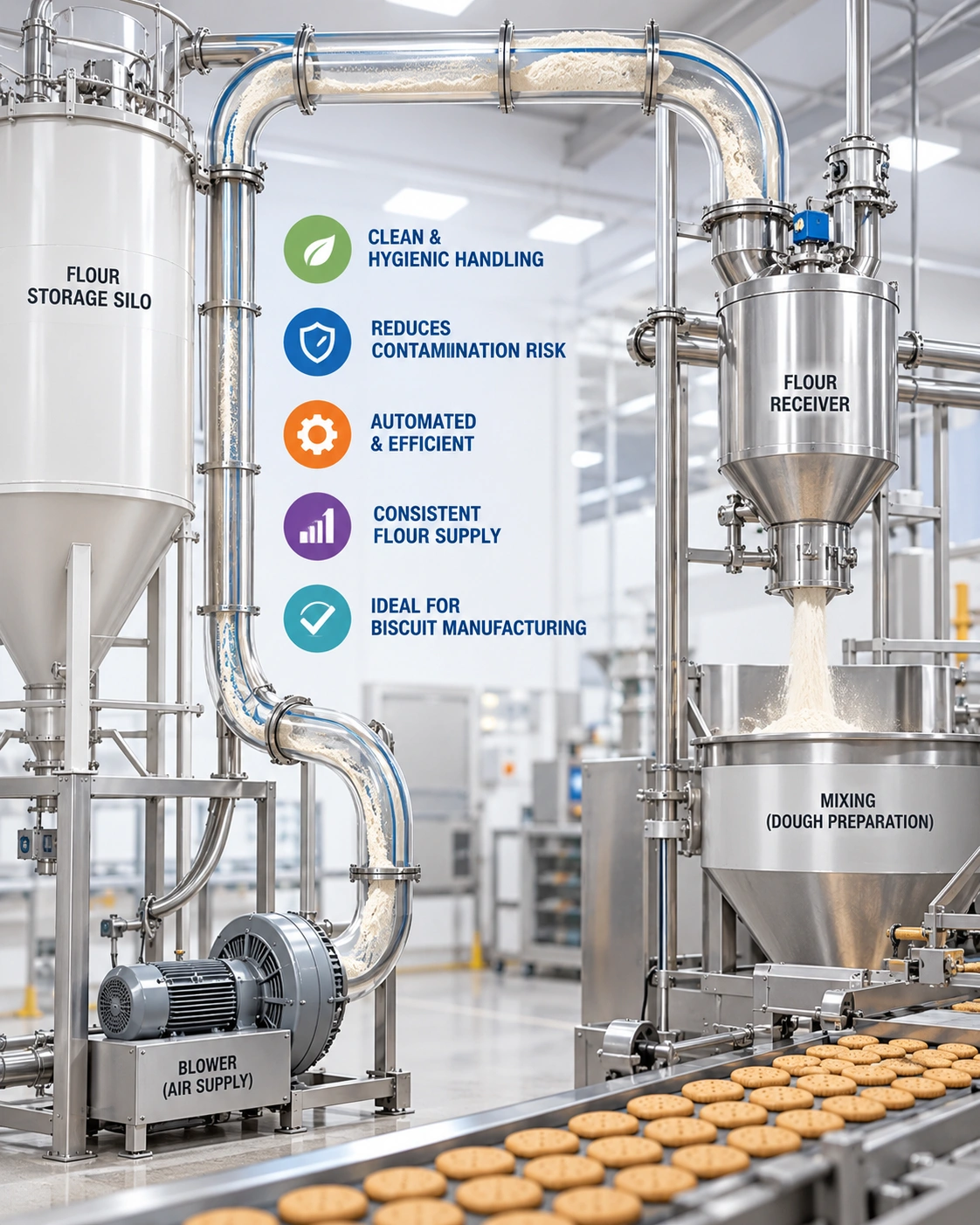
Flour contamination rarely happens at the mixer — it happens earlier, during transfer. Every time flour is scooped, poured, or moved through an open chute, it picks up airborne dust, moisture, and occasionally foreign material from the surrounding environment. A properly designed pneumatic flour conveying system removes that exposure entirely by moving flour through sealed pipework from intake to storage, with no open handling step in between.
This article explains how enclosed pneumatic conveying works, why it is now the standard for biscuit manufacturing plants of any real scale, and what to look for when specifying one.
The Contamination Problem in Manual Flour Handling
Traditional flour handling relies on open transfer points — bags tipped into hoppers, screw conveyors with exposed sections, or manual carrying between process stages. Each of these introduces risk:
- Airborne flour dust settling on equipment, floors, and overhead structures
- Cross-contamination between different flour batches or allergen-sensitive ingredients
- Moisture pickup during open-air transfer, which affects dough hydration downstream
- Foreign material ingress from the plant environment (insects, packaging debris, tramp metal)
Beyond food safety risk, open handling also means 3–5% material loss is common in unenclosed systems — flour that never reaches the dough mixer at all.
What Is a Pneumatic Flour Conveying System?
A pneumatic flour conveying system uses air pressure — either positive pressure (blowing) or negative pressure (vacuum) — to move flour through fully enclosed pipework from the receiving point (bag dump station or tanker unloading) to storage silos, and later to the vibro shifter and weigh hopper stage.
Positive Pressure vs Negative Pressure Conveying
- Positive pressure systems push flour using a blower, suited to longer conveying distances and higher throughput.
- Negative pressure (vacuum) systems pull flour using suction, often preferred for shorter runs and multiple pickup points.
Most biscuit plants in the 1–20 TPH range use positive pressure dilute-phase or dense-phase conveying, chosen based on distance, elevation change, and how gently the flour needs to be handled.
How Enclosed Conveying Eliminates Contamination Risk
Because the entire flour path is sealed, a pneumatic flour conveying system removes contamination risk at four specific points:
- Zero spillage — flour never exits the pipework until it reaches its intended silo or hopper.
- No open exposure — dust, moisture, and airborne contaminants in the plant environment can't reach the product.
- Magnetic separation and screening — inline magnets and sieves catch tramp metal before it reaches the mixer.
- Filtered venting — bin vent filters release only clean air, capturing fine dust rather than releasing it into the plant.
This is also why pneumatic conveying is treated as a baseline control point in food safety audits — enclosed, hygienic transfer directly addresses the contamination risks that open handling introduces.
Additional Benefits Beyond Hygiene
While contamination control is the primary driver, plants that switch to enclosed conveying typically see a few other gains:
- Flexible routing — pipework can move flour around obstacles and between floors without manual rehandling.
- Energy-efficient transfer — modern blower packages are sized precisely to the conveying distance and capacity, avoiding oversized, wasteful systems.
- Lower manpower dependency — no operators needed at intermediate transfer points.
- Reduced housekeeping cost — less airborne dust means less cleaning and lower risk of combustible dust accumulation.
Where Pneumatic Conveying Fits in a Complete Flour Handling System
Pneumatic conveying is one stage in a longer chain: intake (bag dump station or tanker unloading) → pneumatic conveying → food-grade storage silo → vibro shifter → load-cell weigh hopper → dough mixer. Getting the conveying stage right protects everything downstream, since any contamination introduced here carries through to the final batch.
For the complete picture of how this connects end to end, see our guide to the raw material handling system for biscuit manufacturing plants, and our dedicated breakdown of dense phase pneumatic conveying systems for a closer look at equipment sizing and configuration options.
Specifying a Pneumatic Conveying System: What to Check
Not every pneumatic conveying package delivers the same contamination control. When evaluating a system — whether from us or another supplier — a few specification details matter more than the headline capacity figure:
- Conveying velocity — too high and it degrades product or causes excess wear; too low and it risks line blockages.
- Material of construction — SS304/SS316 contact parts are standard for food-grade applications, not optional extras.
- Filter media rating on bin vents — determines how fine a particle is actually captured before air is released.
- Ease of cleaning and inspection access — sealed doesn't mean impossible to clean; look for accessible inspection ports.
A system that looks identical on a capacity datasheet can perform very differently in practice depending on these details, which is why plant walkthroughs and reference sites matter more than brochure comparisons when shortlisting a supplier.
Still Handling Flour Manually Between Process Stages?
If your plant still has open transfer points between intake, storage, and the dough mixer, you're carrying contamination risk and material loss that an enclosed system removes. Our engineers can assess your current layout and propose a conveying design sized to your exact capacity.