Introduction
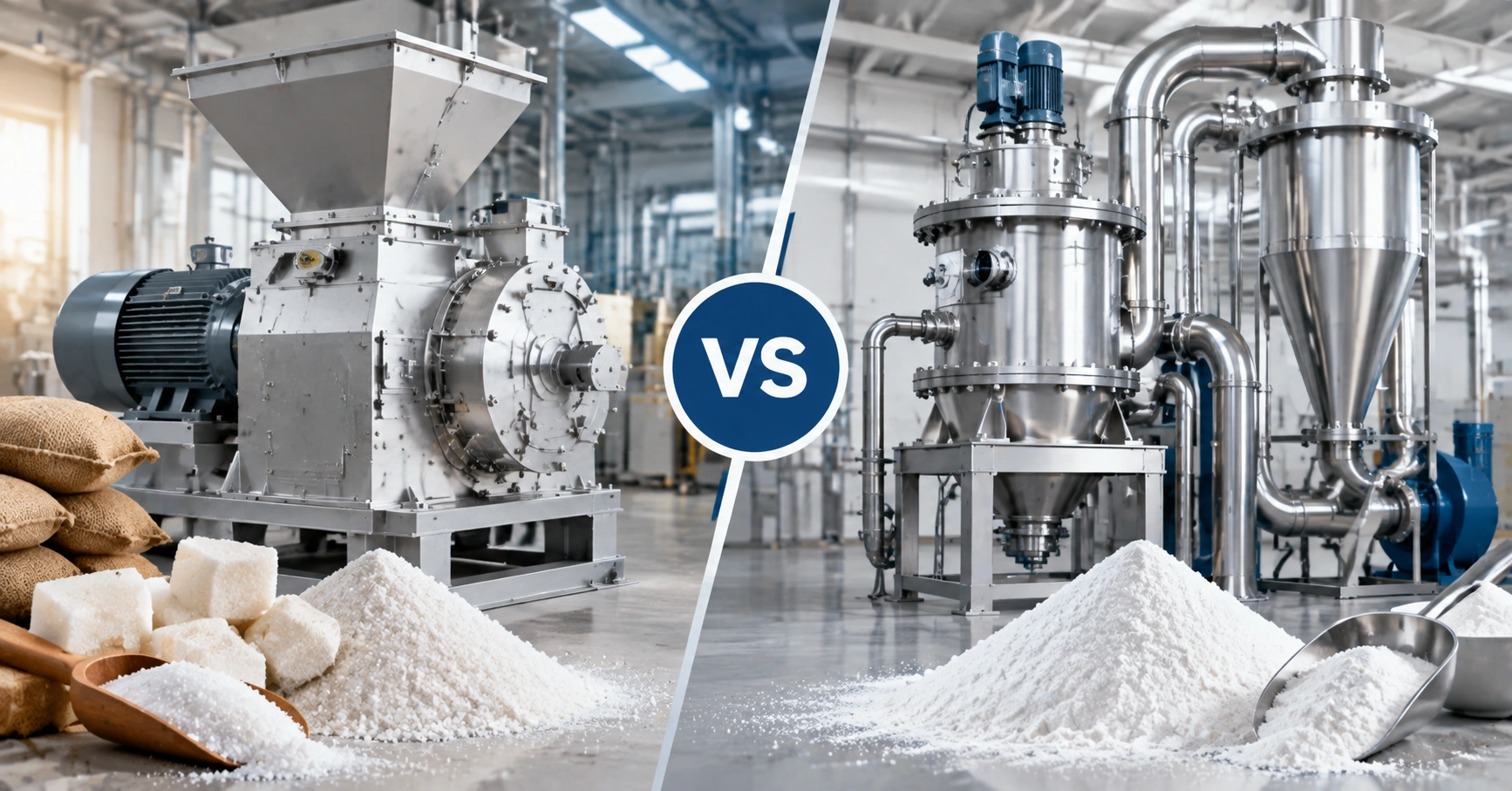
A biscuit manufacturing plant involves several stages, from raw material handling to packaging. This guide covers the complete manufacturing process, essential equipment, plant design, and ways to reduce material waste, improve consistency, and control production costs.
In this guide :
- How a biscuit manufacturing plant works, stage by stage.
- Biscuit manufacturing equipment list by stage.
- Biscuit types and how they change the plant.
- Raw material handling: where margin is won or lost.
- How plant scale changes the design.
- Layout and hygiene design tips.
- Five mistakes to avoid, a conclusion and FAQs.
HOW A BISCUIT MANUFACTURING PLANT WORKS: STAGE-BY-STAGE
PROCESS
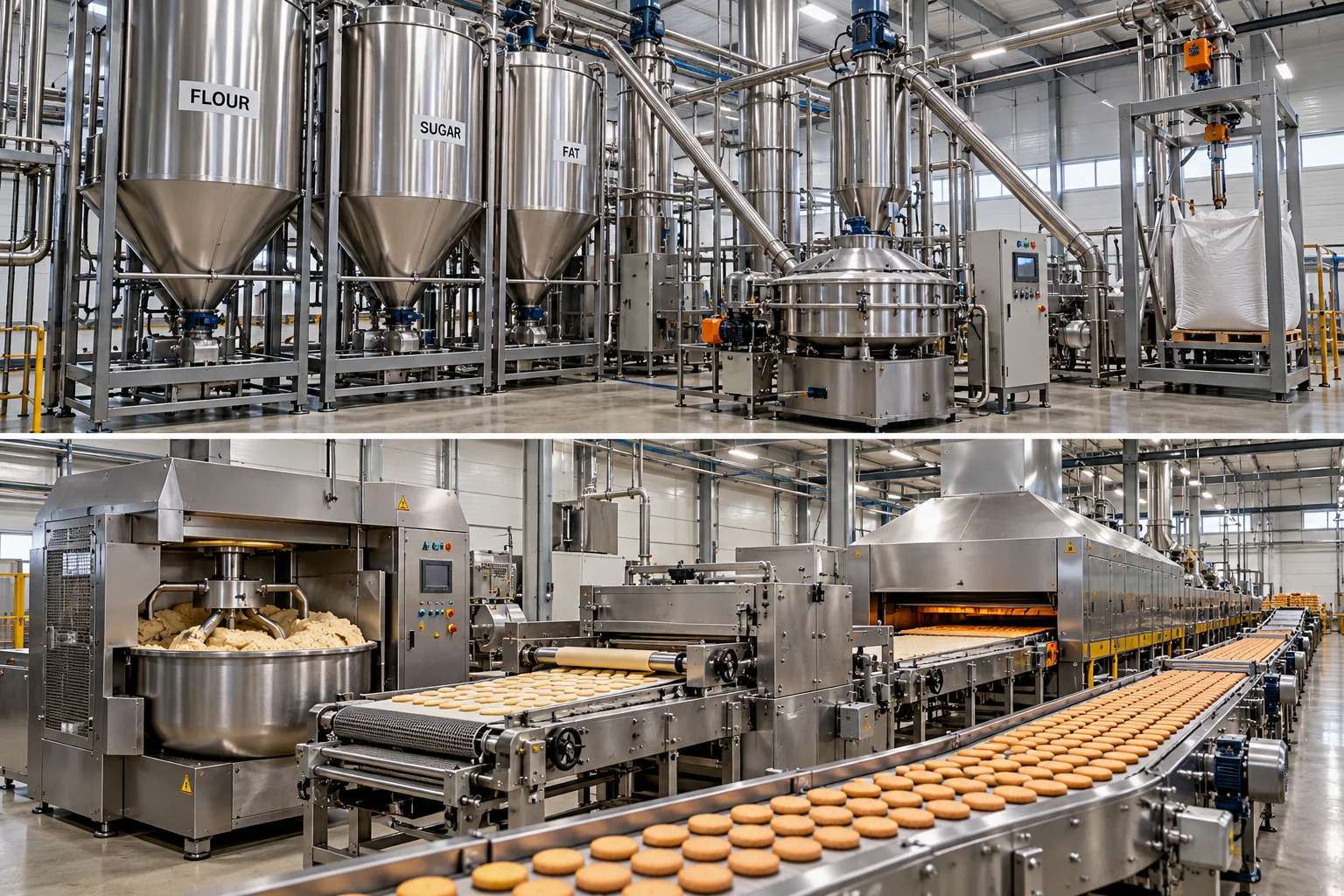
Industry references such as Duncan Manley's Technology of Biscuits, Crackers and Cookies begin the production process with bulk handling and metering of ingredients, then move through mixing, forming, baking, cooling, secondary processing and packaging. The table below maps each stage to its equipment and to the place where plants most often lose yield.
| Stage | What happens | Typical equipment | Where plants lose money |
|---|---|---|---|
| 1. Receiving and storage | Flour, sugar, fats and powders are received and stored | Bag dump station, tanker unloading, silos | Spillage, contamination, stock mix-ups |
| 2. Conveying and sieving | Ingredients move to the process area, are screened and passed over magnets | Pneumatic conveying, Dust Collector, Rotary Valves, Vibro Sifter | Blockages, tramp metal, dust |
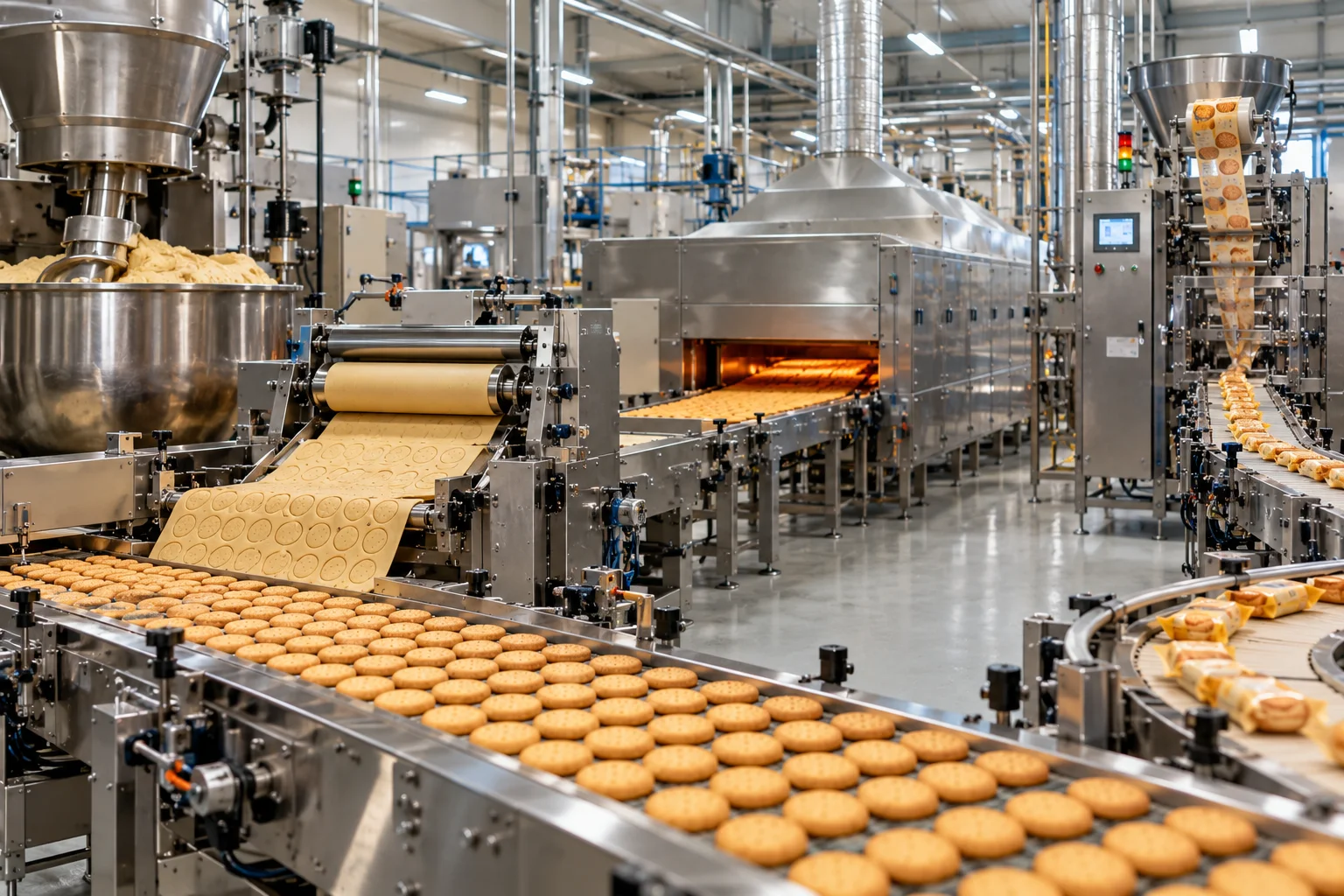
| 3. Sugar grinding | Granulated sugar is milled to 100 to 200 mesh depending Biscuit type | Universal Mill, Air Classifier Mill | Wrong fineness, heat caking |
| 4. Liquid preparation | Fat melting, syrup, emulsifier and flavour dosing | Heated tanks, metering pumps, flow meters | Temperature drift, dosing error |
| 5. Weighing and batching | Recipe dosed by weight | Load-cell weigh hoppers, PLC | Manual dosing variation |
| 6. Dough mixing | Gluten development or creaming, depending on dough | Horizontal and vertical mixers | Over or under mixing |
| 7. Forming | Dough shaped into biscuit pieces | Sheeter and cutter, rotary moulder, depositor | Weight and thickness variation |
| 8. Baking | Moisture driven off, colour and texture set | Tunnel oven | Uneven bake, high rejects |
| 9. Cooling and secondary | Cooling, oil spraying, cream sandwiching | Cooling conveyor, sandwiching machine | Checking (cracking), grit in cream |
| 10. Packaging | Stacking, flow wrapping, cartoning | Stackers, flow wrappers, cartoners | Stoppages, film waste |
BISCUIT MANUFACTURING EQUIPMENT LIST BY STAGE
A biscuit manufacturing plant shares much of its bakery manufacturing equipment with the wider baking industry: mixers, ovens and conveyors look familiar. The difference is tolerance. Biscuits are low-moisture, tightly specified products, so weighing accuracy, sugar fineness and dust control matter more here.
Front end: raw material handling equipment
- Intake : a bag dump station for bagged flour and sugar, or bulk tanker unloading for high-volume plants.Our comparison of the two explains when each pays off.
- Storage :food-grade storage silos for flour and sugar, designed for hygiene and FIFO discharge (see hygienic silo design).
- Transfer : enclosed pneumatic lines. Knitcon's solid handling solutions use pneumatic conveying system to move flour and sugar gently without dust nuisance, segregation or degradation.
- Airlocks : a quick cleaning rotary air lock valve lets operators open and clean the rotor quickly during changeovers, which supports allergen and hygiene routines.
- Milling : a Universal Mill or Air Classifier Mill for sugar, chosen by the fineness you need UM vs ACM compared).
- Liquids : a liquid preparation and handling system for fat, Palm Oil, Lecithin, Sugar syrup preparation, Chemical Dosing and emulsifier, with temperature control and metered dosing.
- Control : load-cell weigh hoppers with PLC batching, and optional SCADA for batch records.
Middle : dough preparation and forming equipment
- Dough mixers : horizontal mixers for hard doughs, creaming and mixing systems for short and soft doughs.
- Forming : sheeter-laminator with rotary cutter for hard biscuits and crackers, rotary moulder for short dough, wire-cut or depositor for cookies.
Back end : baking, cooling and packaging equipment
- Tunnel oven with zoned temperature and humidity control.
- Cooling conveyor sized so biscuits reach packing temperature without moisture shock.
- Oil sprayers, stackers, sandwiching machines, flow wrappers and cartoners.
BISCUIT TYPES AND HOW THEY CHANGE THE PLANT
The product mix decides which machines you buy. Manley's classification separates cream crackers, hard sweet and semi-sweet biscuits, short dough, deposited soft dough, wafers and more. For biscuit manufacturing plant design, four groups matter most :
| Biscuit group | Forming method | Raw material implication |
|---|---|---|
| Hard and semi-sweet (Marie, cream crackers) | Sheeting, lamination, rotary cutting | High flour share, strong gluten development, lean on sugar |
| Short and soft dough | Rotary moulder | High fat and sugar, accurate fat and syrup dosing |
| Deposited cookies | Wire-cut or depositor | Soft dough with inclusions, careful powder and liquid dosing |
| Cream sandwich | Base biscuit plus sandwiching | Ultra-fine sugar (around 200 mesh) and a cream preparation line |
RAW MATERIAL HANDLING: WHERE MARGIN IS WON OR LOST
Flour and sugar are by far the largest ingredients by weight, which makes the front end the place where small inefficiencies turn into large annual losses. A biscuit manufacturing plant that tips bags into open hoppers pays three times: material lost as spillage and dust, labour spent on handling and cleaning, and batch variation that shows up later as rejects.
| Factor | Manual, open handling | Engineered, enclosed handling |
|---|---|---|
| Material loss | Spillage and dust, hard to measure | Contained and traceable |
| Contamination risk | Exposed to plant air and handling | Sealed pipework, filtered venting |
| Batch consistency | Depends on the operator | Load-cell dosing to recipe |
| Labour | Several operators per shift | Supervisory, mostly automatic |
| Traceability | Little or no record | PLC and SCADA batch data |
There is also a safety dimension. OSHA's combustible dust guidance names flour and sugar among the organic dusts that can fuel deflagrations, which is why enclosed transfer, dust collection and grounding belong in the design from day one, not as retrofits. Hygiene expectations are covered by FSSAI requirements for food businesses.
We cover each part of this front end in dedicated articles:how pneumatic conveying reduces flour contamination, five signs your flour handling system is costing you money, and the complete raw material handling system for a biscuit plant. For equipment details, see our raw material handling system for biscuit manufacturing plants.
HOW PLANT SCALE CHANGES THE DESIGN
The same stages apply at every size of biscuit manufacturing plant, but the equipment mix changes. Use these bands as a starting point; final sizing depends on product mix, shifts and growth plans.
| Plant scale (indicative) | Intake and storage | Sugar and liquids | Control |
|---|---|---|---|
| Starter, about 1 to 2 TPH flour | Bag dump station, day hopper | Compact grinder, simple fat melting | Semi-automatic weighing |
| Mid-size, about 3 to 8 TPH | Bag dump station with flour and sugar silos | Universal Mill or ACM, liquid skid | PLC batching |
| Large, 8 TPH and above | Bulk tanker unloading, multiple silos | UM plus ACM, full liquid preparation | PLC with SCADA and batch records |
BISCUIT MANUFACTURING PLANT LAYOUT AND HYGIENE DESIGN TIPS
- Keep flow in your biscuit manufacturing plant one-directional, from raw material receiving to finished goods, so clean and dirty zones never cross.
- Separate the receiving and storage area from baking and packing, and place silos where short vertical conveying lines are possible.
- Fit dust collection at every transfer point, not just at the mill.
- Segregate allergen-bearing ingredients such as milk powder and nuts, with dedicated lines or validated cleaning.
- Specify stainless steel (SS304 or SS316) for product-contact parts and choose equipment that opens quickly for cleaning.
- Reserve floor space and utility capacity for a second line, since expanding a biscuit manufacturing plant later is far cheaper when the original plan allows for it.
FIVE MISTAKES TO AVOID WHEN PLANNING A BISCUIT MANUFACTURING PLANT
- Choosing the oven first and treating raw material handling as an afterthought, when the front end controls consistency.
- Sizing for today's output only, with no allowance for a second shift or line.
- Ignoring sugar fineness until cream quality complaints arrive. Match the mill to the biscuit mix at design stage.
- Leaving out batch data. Without PLC or SCADA records, quality problems cannot be traced to a batch.
- Underestimating combustible dust, which is a design question and not a housekeeping one.
CONCLUSION: BUILD THE BISCUIT MANUFACTURING PLANT FROM THE FRONT END OUT
The best-run biscuit manufacturing plant is rarely the one with the fastest oven. It is the one whose raw materials arrive clean, are stored hygienically, and reach the mixer in the right quantity, at the right fineness and temperature, every batch. Get that front end right and every machine after it performs closer to its rated capacity.
If you are specifying a new biscuit manufacturing plant or fixing an existing one, start with the raw material handling system, then work forward through mixing, forming and baking. Our engineers can size the whole front end to your product mix and capacity.
Frequently Asked Questions
Planning a Biscuit Manufacturing Plant or Upgrading Raw Material Handling?
Tell us what you handle and how much, and our engineers will come back with a sized layout and equipment recommendation. To get a useful answer fast, send us: